Join us Friday mornings at 7:00 am
Breakfast begins at 6:30 am
Freestyle Living
822 Route 28
South Yarmouth, MA 02664
Home Page Stories
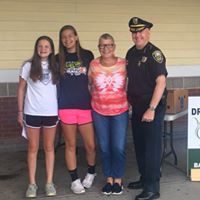
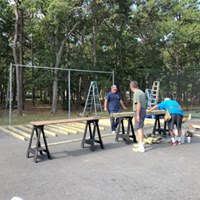
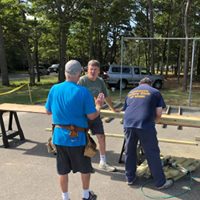
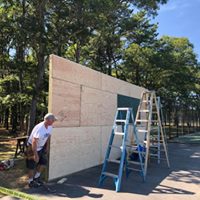
on May 2nd, the Yarmouth Rotary Foundation's president, Jim Seymour, dedicated a flag pole and flag at the newly renovated Parkers River Landing.  Thank you to the Town of Yarmouth and all those who helped make this possible.
 
 
August 16, 2024
PUBLIC SERVICE ANNOUNCEMENT    
HEAR YE! HEAR YE! SPREAD THE WORD, LOOKING FOR A WAY TO SPEND YOUR FREE TIME, CHECK THIS OUT!!!
 
A team of Rotarians from the Rotary Club of Yarmouth worked to create a list of volunteer opportunities, so if you are bored, or looking to fill a few hours, to worthy causes, check it out!
 
The 35th annual 2025Yarmouth Rotary Charity Golf Tournament is scheduled for Thursday September 18th at Cummaquid Golf Course. 
All proceeds raised from this Golf Tournament fund our High School Scholarship Program, help the Yarmouth Food Pantry, Cape Cod Brite Lights and other financial requests received during the year.
Registration starts at 10:30, Lunch at 11:00 and a shotgun start at 12 noon. Dinner and awards immediately after the tournament.
Come join us on the oldest course on Cape Cod, built in 1895. It might be your only chance to play Cummaquid this year. For more information on playing golf or being one of our sponsors, please print out our brochure. You can find the Golf Tournament Brochure in the Home Page Download File Section on the left side of this home page. 
To sign up, please visit our Golf Webpage at: https://www.birdease.com/yarmouthrotarygolf
 
Article published in the Cape Cod Times on Sunday, March 5:
 
WEST YARMOUTH — The demonstrations all over the world on Feb. 24, supporting Ukraine on the first anniversary of the start of the Russian invasion, had special meaning for Emily Stukalo, a sophomore at Dennis-Yarmouth Regional High School.
She recalled being awakened by a friend early that morning at her home in Kyiv a year ago when the alarms alerted that Russian troops were headed there.
 
She was moved this past week by all the support for her country, she said in an interview Monday.
 
“We are really grateful for the help the U.S. has given us.”
 
She is also grateful to be on Cape Cod enjoying life as a normal 15-year-old after living through a tumultuous few months after the war started.

Emily and her parents, Oleksandr and Tamara, and her toy poodle, stayed only a week in Kyiv after the initial invasion before they decided to leave.
She recalled the three-day car trip in two cars with others traveling through Moldova and into Romania.
 
“It was kind of scary,” she said.
 
She told of the generosity of people along the way, offering food and free lodging.
 
“We appreciated it a lot,” she said.
 
When the family got to Romania, they decided to go to Israel where her 36-year-old half-brother and his family live and got an emergency flight, with their dog.
 
That journey was not the family’s first time evacuating. They lived in Donetsk in eastern Ukraine until 2014 when the Russians first took over that area and they fled to Kyiv. Emily’s grandparents still live there, but seem to be safe, she said.
 
Emily’s family stayed only two months in Israel as her parents needed to work, she said. Her father, an endoscopic surgeon, and her mother, a physical therapist, returned to Kyiv in May.
 
“The air raid sirens were not as often as before,” Emily said.
 
How did Emily end up on Cape Cod?
She spent a relatively normal summer with her friends, but then learned that she might have an opportunity to go to the United States as an exchange student.
 
Steve Albright of the Rotary Club of Yarmouth and inbound chairman of Rotary Youth Exchange District 7950 of southeastern Massachusetts, said Monday that early last year the possibility of getting four students from Ukraine had fallen through. He had heard about Emily through a woman in another Rotary district. Emily’s family had a friend in Rotary in Kyiv.
 
He quickly started the process to bring her here, which usually takes several months but was completed in five weeks. Emily got her passport in Kyiv, and had to go to Poland to get a visa because the U.S. Embassy was closed, then immediately flew to Boston.
 
Most exchange students have to pay for the travel expenses, but Steve and his wife, Jill, who chairs the Rotary district’s outbound exchanges, sent a letter to district members, who contributed all of Emily’s expenses.
 
She arrived in September to live with Jim and Victoria Kenny, her host family at their home in Yarmouth.
 
“They are an absolutely awesome family,” Jill Albright said.
 
Safe, but staying connected to family in Ukraine. Emily misses her parents, but they talk on the phone every day.
“They miss me a lot, but they know that I’m safe and don’t get too nervous,” she said.
 
She keeps up on the latest developments in her country and expressed anger at the Russians and sadness that so many Ukrainians are losing their lives. She pulled out her phone to show the Ukrainian coat of arms on her passport. “It means freedom,” she said.
 
She said she loves D-Y and is taking most of the same classes she would be taking as a sophomore in Kyiv. She is in honors trigonometry and German and also takes U.S. history and English. She made the honor roll twice, but was disappointed with only a B-plus in English to keep her from high honors. Her English is excellent — she has been learning it since age 4. She is also doing online courses with her Ukrainian teachers, who give her daily homework.
 
Emily is outgoing and has made many new friends at D-Y, which has two other Ukrainian students sponsored by the United for Ukraine program.
She has been playing sports at the school, including soccer and basketball, and plans to try out for lacrosse. She also skied in New Hampshire during winter break with the Albrights.
 
Jill Albright, the Rotary Club of Yarmouth District 7950 Outbound Chair, said part of the exchange program asks the students to speak at Rotary clubs. Emily said she wants to talk about Ukraine and thank people for their support, but she has to work up her courage to speak to groups.
Albright said she would like more people to know about the Rotary program, which supports 8,000 exchanges a year worldwide.
 
“Our goal is to have one (student) at every school in the area,” she said.
 
Steve Albright is also working on getting a two-year extension of Emily’s stay.
What does it take to have courageous conversations at work or in an organization
(Part 1)
What are courageous conversations?
Courageous conversations involve intentionally giving space to complex issues of social justice, race, and privilege with people at work. These conversations are courageous because they require being bold, openness to sharing your own experiences, and to hearing the experience of others.

Having these difficult conversations means being open to having your viewpoints challenged, as well as directly confronting topics that many of us have been taught to sidestep in polite conversation.
 
Why are courageous conversations so important?
Some may think that they’re doing the right thing by asserting that they don't see color, gender, or other identities at work, but it’s a problematic stance to take. After all, nobody wants to be overlooked. In fact, pretending that these characteristics don't exist allows prejudice and systemic racism to continue to exist.

However, when social and racial justice issues are prevalent — both in the news and in every facet of day-to-day life — being able to ignore them is a privilege. However, doing so undermines trust — both the trust that your employees have in your organization and in society.
 
Being a person of color, non-binary, disabled, the “token” employee, or standing out at work for any other characteristic can be an uncomfortable experience. Having courageous conversations allows everyone to share in this discomfort in the very best way. When people are willing to do the work of challenging and uprooting their assumptions, it brings awareness to and validates these difficult experiences. This in turn creates partnership in the learning experience and in having all employees feel more connected and understood. 

Everyone has a unique experience, no matter who they are or where they come from. Courageous conversations give you the opportunity to share your experiences, have them validated, and be vulnerable. These conversations can be difficult and should be had with intentionality and care. But they are ultimately worth the discomfort if you value creating belonging in the workplace.
 
 
Submitted by Rufus Jones
 
This past weekend I attended a DEI Summit offered by Rotary District 7910 (Metro West and Central Massachusetts. There were over 200 registered participants from around the globe. One of the Breakout Room was a panel discussion on Cultural Competency. In a previous column we discussed what is Culture. This weeks entry defines these two concepts. In Part II we will see how an individual moves from Cultural Competency to Cultural Humility -The Continuum.
 
What is cultural competence?
Cultural competence is a type of social fluency gained by learning about another culture’s language, set of customs, beliefs, and patterns. It
enables service providers to tailor their approach to be culturally responsive and sensitive.
 
What is cultural humility?
Cultural humility is an approach to sociocultural differences that is “self-first.” It emphasizes intersectionality and understanding one’s own implicit biases. This approach cultivates self-awareness and self-reflection, bringing a respectful willingness to learn to inter-personal interactions.
 
The benefits of cultural humility
Intersectionality, diversity, and inclusion are complex topics. In many ways, the only path to making any significant leap from multiculturalism to belonging is through cultural humility. Developing a workplace — as well as a society — that fosters cultural humility and inclusion takes the magnifying glass ’ searing heat off of underrepresented employees. It encourages people to lead with the assumption of their own bias first.
 
Why is this so important?
Race, gender, sexuality, and national origin have all become hypersensitized topics in the world. In order to appear culturally competent, people feel the need to assume a defensive stance. After all, the risks of failure are too great . You could be branded a bigot, ostracize your colleagues, and even end your career. The fact is, though, we all have unconscious biases. They don ’t make us evil — they make us human. The idea of cultural competency gives us a false sense of exemption from these human flaws in perception. In one telling example from Cultural humility versus cultural competence, the researchers describe a nurse so convinced of her own expertise that she actually stereotyped a patient. This bias was based on what she’d learned about people of Hispanic descent in a cultural competency class.
 
What went wrong here? Is cultural competence doing more harm than good?
The problem with this idea is that we ask someone outside of the underrepresented group to state the importance of a different culture in any given scenario. It’s an example of prescribing the problem as the solution. If it were possible for people to do this with any level of accuracy, we wouldn’t have a need for cultural competency in the first place.
 
Sources: Checkout these link for a more detailed discussion
Yarmouth Rotary's 30th Annual Golf Tournament
The Rotary Club of Yarmouth will be holding it’s 30th Annual Golf Tournament, presented by The Cooperative Bank of Cape Cod at the Cummaquid Golf Club on September 24th.
 
Registration and Lunch will begin at 11:30am with a 1:00pm Shotgun start. A buffet dinner with awards will follow the tournament play.
 
The tournament will sell out and golfer registration prior to September 1st is strongly encouraged. 
Team of Four Golfers: $700 and Individual: $175,
Sponsorship opportunities available please contact John Cooke for information, 508-568-3286.
 
  • The Yarmouth Rotary Annual Golf Tournament is the club’s largest fundraiser.
  • Started in 1990, the tournament raised $2,000 in its first year and gave four scholarships to DY High School students.
  • Now in its 30th year, this annual event has raised over $475,000 in scholarship funds benefitting more than 475 students from DY Regional High School & Cape Cod Regional Technical High School.
  • Last year the event allowed the club to provide over $24,000 in scholarships to local graduating seniors.
  • Proceeds from this charity tournament are also used to help support the Yarmouth Food Pantry, the annual Christmas party for deserving children and their families, weekly support of the Meals on Wheels program, and a variety of other local requests through ourm Good Works comittee.
Club Executives & Directors
President
President Elect
Vice President
Treasurer
Secretary
Director, Vocational Services
Director, Club Administration
Director, New Generations
Director, International Services
Director, Community Service
Yarmouth Rotary Foundation Chair
Past President
The Rotary Foundation Chair
Assistant District Governor
Sergeant-at-Arms
Past District Governor 2000-2001
Past District Governor 2019-2020